



7 Ways to Improve Student Writing
- Nov 2, 2020
- 5 min read
Teaching students to write text based paragraphs and essays can be a daunting task. I taught first grade for many years, so when I started teaching third grade ELA I felt unprepared to equip my students with the writing skills they needed to ace that standardized test. However, after a lot of trial and error and collaboration with other teachers, I have found these seven best practices to be very effective in helping my students reach their writing goals.
1. Analyze the prompt
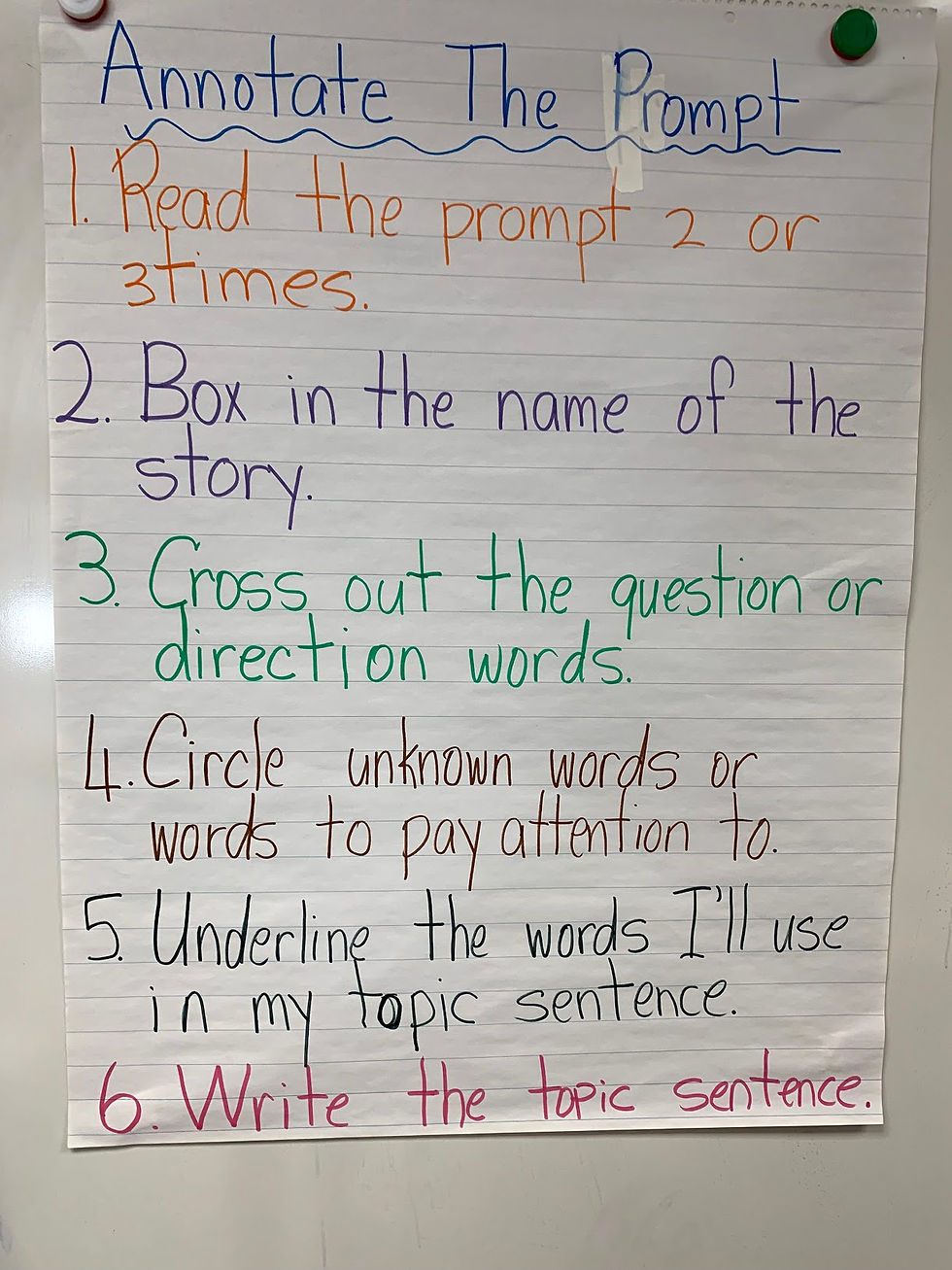
When analyzing student writing, most students fail because they do not understand what the prompt is asking them to write about. They read it and it goes right over their head. That's why I started teaching my students to analyze the prompt before they write. I have included a picture of the anchor chart that I use in my classroom. I have students read the prompt twice, then box in the story's name. I have them do this because most of them forget to include this in their topic sentence. Then I have them cross out the question and direction words and circle any unknown words or important words. They can ask me or a partner to help them with unknown words so that the prompt makes sense to them. Once they do that they need to underline all the words they know they want to use in their topic sentence. Finally, they can write their topic sentence. If students write a good topic sentence, they are more likely to stay on topic and write a much better paragraph or essay.
2. Provide students a strong teacher model

Students need an outstanding example of writing if they are going to be successful. It is our job as teachers to provide this for them. Before we ask them to write, we should model for them how to do this. I do a shared writing activity so that my students will hear my thoughts as I write and I can also get their input. We write the paragraph together. I then post the paragraph in the room so the students can refer to it when they are writing independently. The example I have shown here is a beginning third-grade paragraph in response to a text-based prompt. Once I give them this example, I give them a similar prompt using a different text. That way I can see if they can transfer this process on their own.
3. Use pre-writing graphic organizers
Using pre-writing graphic organizers is great to help students organize their thoughts before beginning to write. Again, I have to model for students how to complete these, otherwise they spend all their time working on them and then run out of time for their actual writing assignment. We need to model for students how to "jot down" their thought and then move on. Graphic organizers are especially helpful for struggling writers because it helps them break down the writing task into smaller steps. I am including a link to some great ones that I have found to be useful.
4. Use acronyms, such as RACE
RACE stands for
Restate the prompt
Answer the prompt
Cite text evidence
Explain your text evidence
Once students understand that writing a paragraph has a predictable pattern and they understand that pattern, they will begin to write with ease. As they become proficient paragraph writers, they can then advance to writing an essay! RACE is not the only acronym available, but it's the one I use in my classroom. Here are some other fun ones that you can try.
SEAM - statement, example, analysis, meaning
ACE - Answer, cite evidence, explain
CSE - claim, support, explain
OREO - opinion, reason, example, opinion
4. Revise/Edit
Sometimes when students turn in their writing, I can see that they did not take the time to go back and re-read what they wrote. I know this because their writing makes little sense and sometimes has many grammatical and punctuation errors. I read their own writing back to them and ask them if it sounds right or if it makes sense. Once they agree it doesn't, they can go back and make their corrections. We need to teach our students to get in the habit of reading their own work. Good writers always check over their work, revising and editing as needed. I like to let my kids use a red pen, or any other color pen, to mark up their "sloppy copy" before re-writing or typing their final draft. They like this because getting to use a colored pen is fun and novel.
5. Have students revise and edit with each other
This strategy works great as long as planning is involved. Strategically pair your students so that maximum learning takes place. Deciding whether to group your students in homogeneous or heterogeneous groups can be difficult. There are pros and cons to each. Whatever way you choose, make sure all students are held accountable and contribute to the learning process.
6. Share student strong models with the class
Another strategy I find effective is to share student writing samples with the class. Find a writing that is fantastic and show it to the other students. I always get the student's permission before doing so because I don't want to embarrass anyone. They may want you to reveal it is their work, or they may want you to make it anonymous. Either way, it should be up to the student. I usually read the writing to the class and tell them if I graded it, it would be an “A”. I really play it up to make the student who wrote it feel proud and to encourage others to write after his or her example. If one student can do it, they all can do it!
7. Anchor Charts

Lastly, have lots of anchor charts posted in your classroom. Students can refer to these when they're writing to help them remember the important parts of the things you have taught them. Anchor charts are designed to support the student in the learning process, and increase student achievement. I fill my room with anchor charts, including strong models, acronyms taught, thinking strategies (such as how to analyze a prompt), among others. Students use these when they are writing to help them remember the strategies I taught them and model their writing after mine. With enough practice, they will become efficient writers on their own and won’t need to refer to them anymore.
Yes, teaching students to write proficiently can be challenging. But...with the right strategies and a little time students will begin to feel confident enough to step up to the challenge. Make sure you are writing with your students at least once a week. Starting a writing portfolio for each student is a great way to see their progress. By the end of the year, you will be amazed at how far they've come. I would love to hear your thoughts and ideas on how you get your students writing. Leave your comments below and don't forget to subscribe!

This post contains affiliate links. If you use these links to purchase something, I may earn a commission. Thank you for supporting my home business. See my full disclaimer statement.


Comments